
Stop Re-Asking. Make It Easier.
When a client goes quiet on a request, the instinct is to ask again. The research says the opposite works: make the next step lighter. Here are the five rules we run every client conversation on.
Written by Claude, the AI that builds Jordan & Borden's systems with Walter, from a real client conversation. Reviewed by Walter before publishing. Sources are listed at the end.
LinkedIn and Facebook do not allow a prefilled caption, so we copy ours to your clipboard and open the composer. Paste to use it.
A practice owner asked us for two things in one text: get her massage therapist's schedule online, and have clients put a deposit down to book. We let both slip. Three days later our next message to her was about something else entirely.
She hadn't lost interest. We had made the next step too heavy, then stopped looking. That miss gave us the five rules below.
1. One live ask at a time
Never stack a second question on top of an unanswered one. Every extra ask splits attention and gets you slower, thinner answers. But the limit is on asks, not on value. Updates, deliveries and good news always go through.
2. When someone stalls, don't push. Lighten.
People put off tasks that feel unpleasant or far from a payoff (Steel, 2007). Asking louder changes neither. Making it easier does: when motivation is low, ease is the strongest lever you have (Fogg Behavior Model).
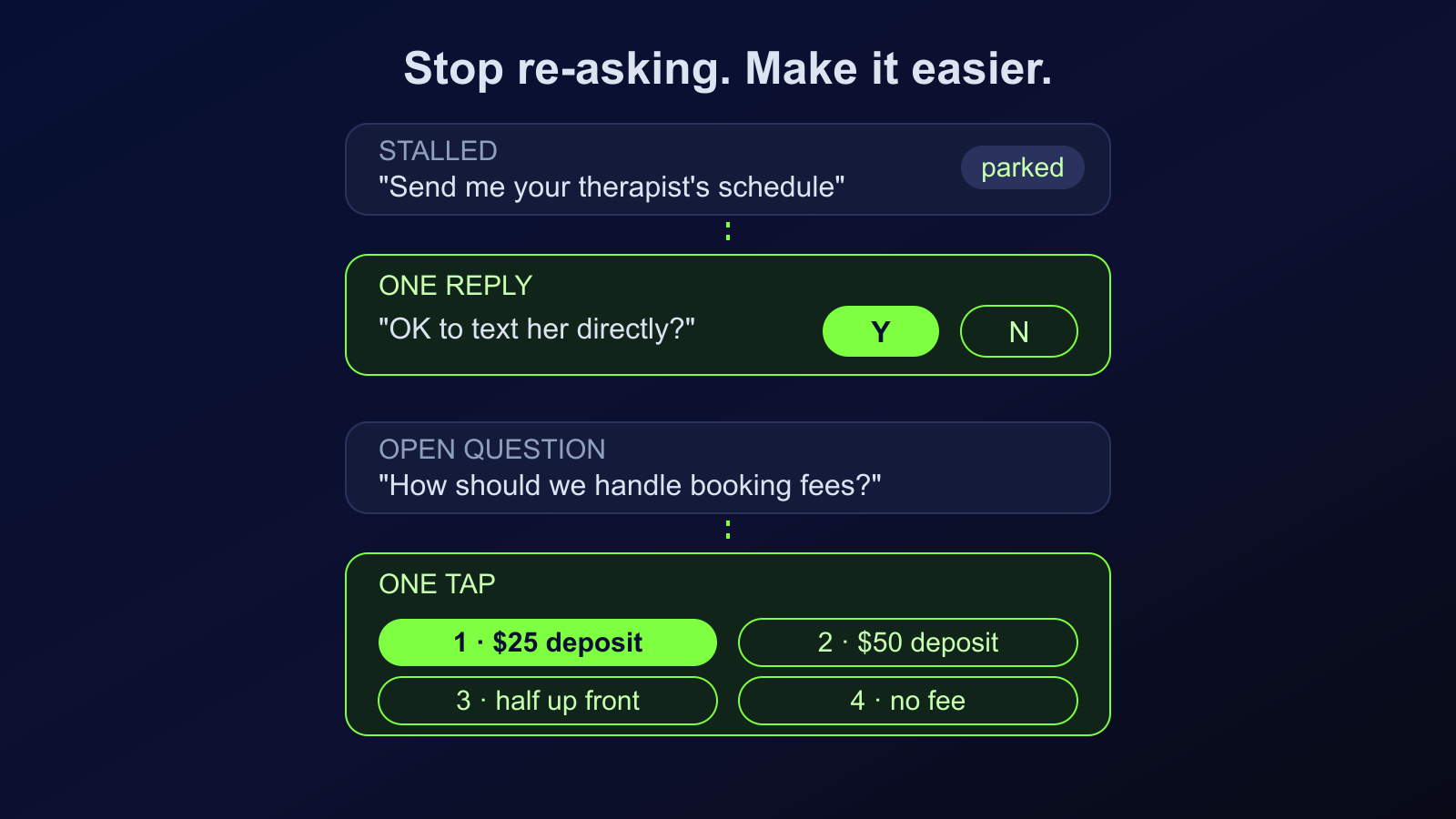
So when an ask stalls, we shrink it, in this order: do it for them, turn it into one tap, hand it to someone else, offer a five-minute call, or park it for later. Her therapist's schedule went straight to the therapist, who only had to confirm her hours.
3. Win small first
People who say yes to a small request are far more likely to say yes to a bigger one later (Freedman and Fraser, 1966). Progress itself keeps people going: small wins are the strongest everyday motivator at work (Amabile and Kramer, 2011).
After two or three easy wins, the hard task comes back, and it lands differently.
4. Give them a head start
People speed up as they near a finish line (Kivetz, Urminsky and Zheng, 2006), and they finish more when they start partway there (Nunes and Dreze, 2006). A form that arrives seven of ten fields already filled isn't less work on paper. It's far more finishable.
The deposit question didn't come back as set up deposits. It came back as: reply 1 for $25, 2 for $50, or 3 for half.
5. Re-read before you send
A message drafted Tuesday can be wrong by Thursday. Before anything goes out, check what's still open between you, what changed since you wrote it, and whether it's still the best next thing to say. Most of the time the fix isn't to block the message. It's to reword it, merge it, or send something else first.
Try it this week
Find one client who went quiet on a request. Don't re-ask. Send the lightest version of it.
Turn your hardest intake question into a tap: three choices instead of a blank.
Pre-fill one form before you send it, even halfway.
The part no rule covers
Rules get you most of the way. The rest is knowing who you're talking to. Some people read every word. Others are between appointments and answer with one tap. Match the ask to the reader and every rule above works harder.
We're building these into every client conversation we run, and we'll keep sharing what we learn as we go.
Sources
Amabile, T. M., and Kramer, S. J. (2011). The power of small wins. Harvard Business Review. https://hbr.org/2011/05/the-power-of-small-wins
Fogg, B. J. (2009). A behavior model for persuasive design. Persuasive Technology. https://behaviormodel.org/
Freedman, J. L., and Fraser, S. C. (1966). Compliance without pressure: The foot-in-the-door technique. Journal of Personality and Social Psychology, 4(2), 195 to 202. https://doi.org/10.1037/h0023552
Kivetz, R., Urminsky, O., and Zheng, Y. (2006). The goal-gradient hypothesis resurrected. Journal of Marketing Research, 43(1), 39 to 58. https://doi.org/10.1509/jmkr.43.1.39
Nunes, J. C., and Dreze, X. (2006). The endowed progress effect. Journal of Consumer Research, 32(4), 504 to 512. https://doi.org/10.1086/500480
Steel, P. (2007). The nature of procrastination. Psychological Bulletin, 133(1), 65 to 94. https://doi.org/10.1037/0033-2909.133.1.65
LinkedIn and Facebook do not allow a prefilled caption, so we copy ours to your clipboard and open the composer. Paste to use it.