Madison Wanted to Learn Agentic Coding. So We Built a Game.
We started with a plain tic tac toe game from GitHub. Madison gave the coding agents a direction, judged every version, and ended up with a game that has her name on it. Here is what she actually learned.
Founder of Jordan & Borden. Worked alongside Madison on the project described here.
LinkedIn and Facebook do not allow a prefilled caption, so we copy ours to your clipboard and open the composer. Paste to use it.
Madison is a freshman at South Cobb High School, and she wants to learn agentic coding. So we built something together.
That phrase can mean almost anything right now. A teenager can watch a video about AI, copy a prompt, get a block of code back and say they built something. None of that tells them what it feels like to make decisions inside a real project.
So we started with something small enough to finish and clear enough to judge: tic tac toe.
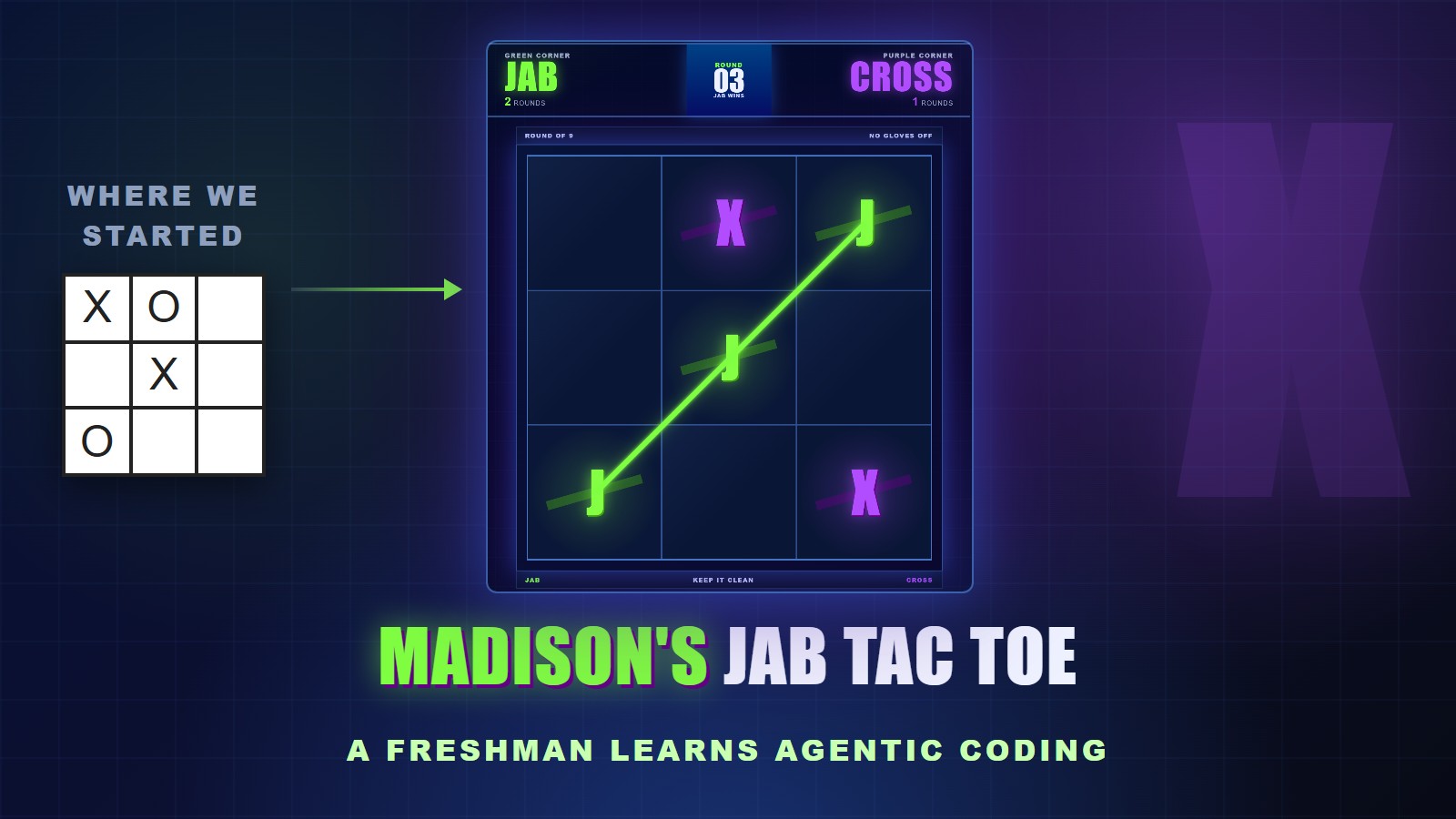
We found a simple version of the game someone had published on GitHub Pages (it is linked at the bottom of this page). It worked. A title, a nine square board, Xs and Os. There was nothing wrong with it. It just did not have a point of view.
Madison did.
The first instruction was not technical
The most important early feedback had nothing to do with JavaScript. It was about identity.
Madison looked at the first version and said it did not feel like JAB. She wanted neon green, purple and blue. She wanted her name at the top. She wanted it to look like something JAB would put its name on.
That is a real product decision. It gave the coding agent a direction specific enough to act on, and left Madison free to judge the result.
The plain board became Madison's JAB Tac Toe. JAB fights from the green corner, CROSS from the purple corner, and the board sits in a dark blue ring with a scoreboard, sound, a round counter, a glowing win line, a two player mode and a Spar Bot to play against.
None of that matters because tic tac toe needed more features. It matters because every change was another rep of the loop that makes agentic coding useful. Say what you want in plain language. Look closely at what the agent made. Notice what does not fit. Give the next instruction and test it again.
The agent can write the code. It cannot decide whether a design feels like JAB. That takes a person who knows what JAB is supposed to feel like.
The project did not live inside a demo
We started the game in an ordinary project folder on a PC using ChatGPT Codex. Then we opened the same folder with Claude Code for the next visual pass, and finished the work through a remote connection to the same machine.
That detail is worth saying out loud. Nothing disappeared when we switched tools or stepped away from the desk. The files were still there. Madison could see each change, refresh the browser and decide what to improve next.
That is much closer to how real software gets made than a one-off prompt in a chat window.
Testing found a bug the screenshots missed
We played rounds instead of stopping at a screenshot, watched the score update, and checked the layout at desktop and phone sizes. It looked done.
It was not. While we were putting this article together, a diagonal win drew the glowing line straight off the side of the board instead of through the three winning marks. The bug had been there since the very first version. Every earlier check had used a straight across win, where the line happens to land in the right place.
The fix was two lines. The lesson is the part worth keeping: a test only proves the case you actually ran. Try the other ways it can go.
What Madison actually learned
She did not need to memorize HTML, CSS and JavaScript before she could take part. She did need to learn how to direct work, inspect it and hold the result to a standard.
That is the part people miss when they describe agentic coding as having AI build an app for you. The person is not removed from the work. Their job shifts toward judgment.
Madison chose the look. She said the first palette was wrong. She asked for her name at the top. She looked at every version and decided what came next.
Tic tac toe is a small project, on purpose. The goal was never to turn Madison into a software engineer in one afternoon. It was to give her one complete cycle she can repeat: start with an idea, use an agent to move faster, test the result and make it her own.
That is a much better first lesson than a slideshow about what AI might do someday.
Why we teach it this way
At JAB we use agentic tools to build systems for businesses. We use the same tools in our student coding workshops, because young people should get to work with the real tools that are changing how software gets made.
The goal is not to hand someone a finished answer. It is to give them a project they can direct, improve and take home.
Madison's game has her name on it now. More importantly, she knows what she did to get it there.
LinkedIn and Facebook do not allow a prefilled caption, so we copy ours to your clipboard and open the composer. Paste to use it.