
How We Raised Our Google Ads Optimization Score to 92%
We turned our own AI ops layer loose on our ad account. It reads the numbers every day, catches the small leaks a busy owner never sees, and hands back a short list of fixes to approve. Here is the method.
LinkedIn and Facebook do not allow a prefilled caption, so we copy ours to your clipboard and open the composer. Paste to use it.
Most small businesses that run Google Ads are quietly losing money in places they never look. Not in one obvious way, but in a dozen small ones. A keyword that gets clicks and books nothing. A search term you are paying for that has nothing to do with what you sell. An ad whose click rate has quietly gone soft. None of it is dramatic. All of it adds up, and almost none of it gets caught, because catching it means reading the report every single day.
So we did something simple. We pointed our own AI ops platform at our own ad account and let it do the reading. This is the same discipline we sell, run on ourselves, and the numbers are real. Here is what it actually does.
It reads Google's own scorecard every day
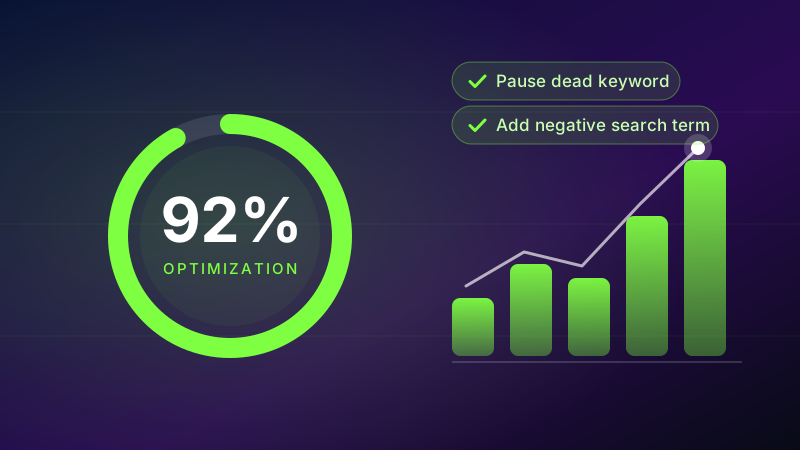
Google gives every ad account an optimization score, a percentage that estimates how well the account is set up to perform. Most owners never open it. Our system syncs it daily and treats it as a running health check. As of this writing our account sits at 92 percent, and the point is not the number itself. The point is that the number moved because the system worked a list, not because anyone spent an afternoon in the console.
It turns vague advice into a short list of real fixes
The difference between Google's raw recommendations and something an owner can act on is specificity. Instead of a generic nudge, the system produces plain findings tied to real dollars. A few from our own account, verbatim in spirit:
Wasted spend: a keyword had taken 15 clicks and almost 19 dollars over two weeks and booked nothing. Recommendation, pause it. Negative keyword: a search term unrelated to our offer had pulled 8 clicks and nearly 10 dollars. Recommendation, add it as a negative so we stop paying for it. Weak ad copy: one ad's click rate had slipped under one percent. Recommendation, refresh the headlines. Weak keyword: a broad term was getting impressions but barely any clicks. Recommendation, tighten the match type.
None of these are big on their own. Together they are the difference between a budget that compounds and a budget that leaks.
Nothing changes without a human saying yes
This is the part that matters most, and it is where a lot of automation goes wrong. Our system never touches the live account on its own. Every fix, pause a keyword, add a negative, rewrite an ad, adjust a budget, lands in an approvals screen as a one-click action. The owner clears the ones that make sense and ignores the rest. The machine does the watching and the drafting. The person keeps the judgment and the final call.
That balance is the whole design. You get the vigilance of something that reads the report every day, without handing your money to a black box.
The same method fixes the website, not just the ads
Ad spend is only half the leak. The other half is the page the ad sends people to. If your site loads slow, hides what you do, or is missing the structured data that search engines read to understand your business, you pay for the click and lose the customer anyway.
So the same closed loop runs on the site itself. The system audits technical fitness the way a search engine sees it, flags what is missing or weak, and queues the fixes. Clean structured data, clear local business signals, fast pages. The score that measures that fitness is one we are actively raising right now, using the exact process described above. It is not finished, and that is the honest version. What matters is that it is being worked as a list, in the open, the same way the ad account was.
Why we run this on ourselves first
We do not sell a dashboard for you to go read. We run the ops layer, watch the numbers, and bring you a short list of decisions. Doing it on our own account first is how we know it holds up. The waste it caught on us is the same waste sitting in most local ad accounts and most local websites right now, unseen.
If you want to know where your own leaks are, the fastest way is to look. Our free audit checks your site the way a new customer and a search engine both would, in about 30 seconds, and tells you what is costing you.
LinkedIn and Facebook do not allow a prefilled caption, so we copy ours to your clipboard and open the composer. Paste to use it.